Protecting Health Through the One Health Approach
ABOUT ECOMORE
The Economic development, Ecosystem Modifications, and emerging infectious diseases Risk Evaluation (ECOMORE) program is a regional initiative designed to strengthen health security across Southeast Asia (Laos, Cambodia, Vietnam and the Philippines). Supported by the Agence Française de Développement (AFD) and coordinated by Institut Pasteur (Paris), this project is part of a larger effort to help countries prepare for and respond to epidemics.
Since pathogens do not recognize borders, ECOMORE uses a “One Health” approach. This means our experts work together to understand how the health of humans, animals, and the environment are all connected to prevent the next big outbreak.
Southeast Asia is a critical area for the emergence of new diseases because of rapid population growth, changes in land use, and a fluctuating climate. These factors play a role in higher frequencies of disease outbreaks such as Dengue, Zika, Chikungunya, and Avian flu.
In Laos, the project is led by the Institut Pasteur du Laos (IPL). As a national institute under the Lao Ministry of Health, IPL aims to translate scientific research into real-world public health actions. The team in Laos is focused on tracking how diseases spread between insects, animals, and people to keep communities safe. By moving beyond general monitoring to a more precise approach, specific data on local disease transmission can be collected and analyzed, so that health authorities can take informed actions in locations and times of need.
Programme Objectives
Main Goals:
- Strengthen One Health: Improve how actors from the human, animal, and environmental health sectors work together.
- Better Lab Tools: Give laboratories the latest technologies to identify diseases quickly and accurately in resource-limited settings.
- Use Climate Data: Learn how weather and environmental changes affect where and when diseases emerge.
- Coordinate Regionally: Create a system where different countries can share information and respond to threats as one team.
Specific Goals for Laos:
- Estimate Infection Burdens: Figure out exactly how many people have been exposed to specific pathogens.
- Develop Faster and Better Tests: Create simple, rapid tests that can be used in remote areas.
- Track Disease Carriers: Study and map the mosquitoes that carry dangerous viruses.
Key activities
Our work in Laos is divided into four main areas:
- Advanced Laboratory Testing: We have recently established Multiplex Microsphere-based Assay (MIA) technology in Laos. This powerful tool allows to test a blood sample for up to 100 different diseases at the same time.
- Rapid Diagnostic Kits: Our scientists are developing “in-house” testing kits for Chikungunya virus (CHIKV). These tests are designed to be simple and fast, making them perfect for use in the field.
- National Health Snapshot: We are conducting a large survey involving 1,200 households (about 3,000 people) across three different regions of Laos. This helps us to understand the history of infections across the country.
- Tracking Mosquitoes: Our teams regularly go into the field to trap and identify mosquito species, and study how climate and land-use changes affect where these insects live and breed.
Capacity Building
The best way to ensure long-term safety is to train and empower local professionals.
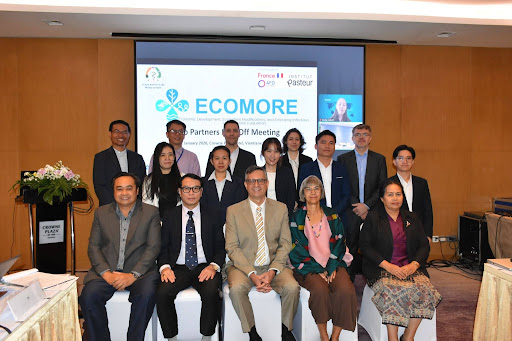
- Kick-Off Meeting: We begin by meeting with national health leaders [GW1] of Laos to inform and discuss strategic implementation of ECOMORE activities, ensuring that our work follows national laws and helps reach the health goals of Laos[GW2] .
Participants:
Institut Pasteur du Laos (IPL)
- Dr. Philippe BUCHY, Director General
- Dr. Gary WONG, Head of Virology Laboratory, focal point for Laos
- Dr. Sengdeuane KEOMALAPHET, Project Manager
- Ms. Manilath NALONGSACK, Climate Change Research Fellow
- Dr. Khamsing VONGPHAYLOTH, Head of Entomology Laboratory
- Dr. Vincent LACOSTE, Responsible of the Medical Virology Group, Virology Laboratory
- Ms. Phouvannamalee VILAYSOUK, Administration Officer
Institut Pasteur du Cambodge (IPC)
- Emilie CARLOT, (online)
Cooperation and Cultural Affairs at the French Embassy to Laos
- Mrs. Natalie BRAT
- Dr. Thomas VALLEE
- Ms. Eloise VALY, Health Policy at the French Embassy to Laos
Department of Communicable Diseases Control (DCDC)
- Dr. Phoupasong SOMPHOU, Deputy Director of DCDC
World Wide Fund for Nature Laos (WWF-Laos)
- Mr. Sansani KHODPHOUTHONE, Senior Project Officer
Lao Tropical Medicine and Public Health Institute (Lao TPHI)
- Dr. Khampheng PHONGLUXA
- Dr. Sysouphanh MANY
National center for laboratory and epidemiology (NCLE)
- Dr. Boualay NORCHALEUN
- Dr. Chanthavy SOULAPHY
- Workshops & Training: We will host technical and knowledge transfer sessions, where participants learn new methods, such as isothermal amplification of nucleic acids for diagnostic purposes (simple molecular testing). We will also hold sessions for community workers to help them engage with local families about health risks.

Kick-Off Meeting of PIMES
Workshop
Field Work
Steering Committee
Results
Our Partners
Funded by
Coordinated by
Our Regional Partners