PIMES
Approche « Une santé » de renforcement des capacités du Laos dans la prévention de l’émergence des virus d’origine zoonotique: création d’une Plateforme Innovante de diagnostic Moléculaire Et Sérologique
Using the One Health approach to strengthen Lao PDR’s capacity to prevent the spread of emerging pathogens from animals to humans, with a focus on developing new innovations in molecular diagnostics and serology (PIMES).
In collaboration with the Institut Pasteur in Paris, this project focuses on establishing a platform for identifying new and neglected pathogens by developing specific molecular and serological diagnostic tools. These tools will be used to detect emerging infections and to study their prevalence in humans and animals. The project also aims to strengthen the capacity of Lao and regional partners through training on a range of topics, including the use of bioinformatics tools for pathogen discovery and prototype antibody design, the development of RPA/LAMP molecular diagnostics, and the creation of serological (LIPS) tools to complement high-quality diagnostic methods.
- Background
- Objectives
- Methodology
- Collaboration
- Funding
- Results
Zoonotic diseases, which are transmitted from animals to humans, pose a significant threat to public health. The COVID-19 pandemic is a recent example that demonstrates on a global level the severe consequences when a causative pathogen cannot be accurately identified and controlled in a timely manner. Factors such as deforestation, climate change, and globalization increase the risk of pathogen spillover to humans. The “One Health” initiative aims to reduce the risk of diseases at the interface between humans, animals, and the environment. PIMES is a project aligned with the “One Health” initiative by improving the capacity to rapidly and accurately identify new viruses circulating in humans and animals.
This project aims to develop cutting-edge, high-performance molecular diagnostic tools to detect new viruses in samples collected from humans and animals in Lao PDR. These tools can theoretically be generated and validated within weeks if the viral sequence is known, contributing to a rapid response against emerging outbreaks. They can also be used to estimate the prevalence of these pathogens in the population and strengthen surveillance efforts in Lao PDR. The establishment of this novel diagnostic platform will allow local researchers to be trained in developing these techniques against any known or novel pathogens, forming an essential link for the successful control and prevention of infectious disease outbreaks.
The milestones and indicators of the project include training local researchers on in silico antigen design, developing and validating molecular assays to detect emerging viruses, establishing a map of pathogen circulation, and assessing spillover risks. The results will be shared with national and international health authorities, funders, and other stakeholders in the form of reports and meetings, as well as with the general public through the project webpage.
The agenda for in silico antigen design includes: identifying homologous structures with BLAST; sequence alignment with MAFFT; building homology models of viral proteins in complex with receptors or antibodies; structural analysis with MDAnalysis; building models of viral proteins with AF2/AF3; identifying similar structures in complex with antibodies or receptors; building models of protein complexes with AF3; quality assessment and binding free-energy estimation; structural analysis with MDAnalysis; predicting protein–protein interactions with AI; and a HADDOCK tutorial on antibody–antigen modelling.
1. Laboratory capacity building. To establish a new platform for developing novel serological and molecular diagnostic tools targeting priority viruses, and to estimate the presence and circulation of these pathogens in humans and animals.
2. Training. To train a team of young Lao researchers to ensure they acquire the necessary skills to work with these new technologies.
The steering committee will regularly monitor project progress and facilitate communication among the various organizations and authorities involved. Ultimately, this project aims to strengthen existing laboratory and research capacity and support rapid outbreak response, leading to effective prevention and control of zoonotic diseases in Lao PDR.
3. Communication. To share the study results with the Lao Ministry of Health, relevant Lao institutional collaborators, and international public health authorities.
Training workshops.
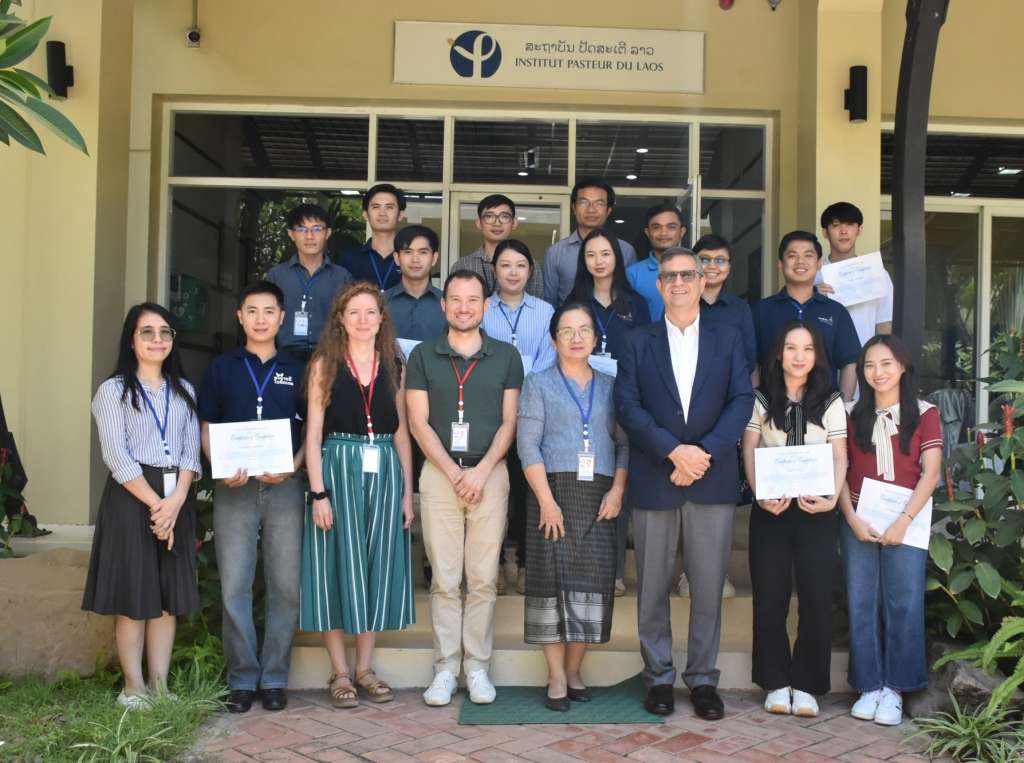
From September 18 to October 4, two workshops were held on bioinformatic analysis and in silico antigen design as part of knowledge transfer and capacity building. The trainers were experts from IP Paris: bioinformatics (Drs. Thomas BIGOT and Julia KENDE) and antigen design (Drs. Massimiliano BOMONI and Vincent SCHNAPKA).
Invitations to attend were sent to staff researchers at Lao partner institutes, including the Department of Communicable Disease Control (DCDC) and the National Centre for Laboratory and Epidemiology (NCLE), Lao Ministry of Health; the National Animal Health Laboratory (NAHL), Lao Ministry of Agriculture and Forestry; the Lao-Oxford-Mahosot Hospital-Wellcome Trust Research Unit (LOMWRU); and Centre Infectiology Lao–Christophe Mérieux (CLIM). Regional invitations were also extended to staff from the Institut Pasteur du Cambodge (IPC).
The training consisted of both theoretical (classroom) and practical (computer-based) components. The bioinformatics agenda included fundamentals of bioinformatics, next-generation sequencing and alignments, introduction to bioinformatics databases, genome assembly, functional and taxonomic annotation, consensus and variant calling, homology and phylogeny, and a summary of concepts relevant to pathogen discovery.
Lectures were recorded for future training purposes and to support trainees who were unable to attend certain sessions due to unforeseen circumstances. All recordings were stored on the IPL server. Trainees who successfully completed the program received certificates of completion (Figure 2A–B).
The courses were well received, with overwhelmingly positive participant feedback and clear improvements in trainees’ proficiency in bioinformatics and in silico antigen design.
- Institut Pasteur (IP) Paris, France.
- Ministry of Foreign Affairs, France.
Over 20 staff members from IPL, DCDC, NCLE, NAHL, LOMWRU, CILM, and IPC attended the basic bioinformatics and in silico antigen design training sessions (Figure 1A–B).
For the basic bioinformatics session, hands-on exercises were conducted using Galaxy installed on IPL’s in-house server, along with additional open-source software covering a broad range of bioinformatics tasks. These included quality checks of Illumina and ONT sequence data using FastQC, MultiQC, NanoPlot, and PycoQC; taxonomic classification with Kraken2; de novo assembly using Velvet; genome annotation with Augustus and Prokka; variant calling with GATK; and phylogenetic reconstruction using Seaview.
For the in silico antigen design session, the practical component introduced several approaches, including homolog-based identification using MAFFT and Modeller; AI-based structure prediction and homolog identification with AlphaFold3 and Foldseek; geometric deep-learning methods using PeSTo and ScanNet; and physics-based docking with HADDOCK. Trainees were provided with the required tools and Python scripts to predict the antigenic domain of the BANAL-52 coronavirus and estimate its antigen–antibody binding affinity. In addition, trainees were assigned an exercise to predict the antigenic region of a given amino acid sequence using the skills learned during the workshop, and to present their results on the final day.
Lectures were recorded for future training purposes and to support trainees who were unable to attend due to unforeseen circumstances. All recordings were stored on the IPL server. Participants who successfully completed the training were awarded certificates of completion (Figure 2A–B).
The courses were well received, with overwhelmingly positive participant feedback and clear evidence of improved proficiency in bioinformatics and in silico antigen design.
Our partners